Configuration Variables (CV)
Note
CV.hcontains default values for every CV. When your board is still “factory new” these values are automatically written into flash.CV_65 == 255indicates a factory condition and resets all CVs to default.Index 0 in the CV array corresponds with
CV_1, index 1 corresponds withCV_2and so forth.
Reset all CVs
To reset all CVs to default, a value of 8 can be written to CV8. Alternatively write a value of 255 to CV_65 this will also reset all CVs to default, but only after power cycling the decoder.
Speed step configuration
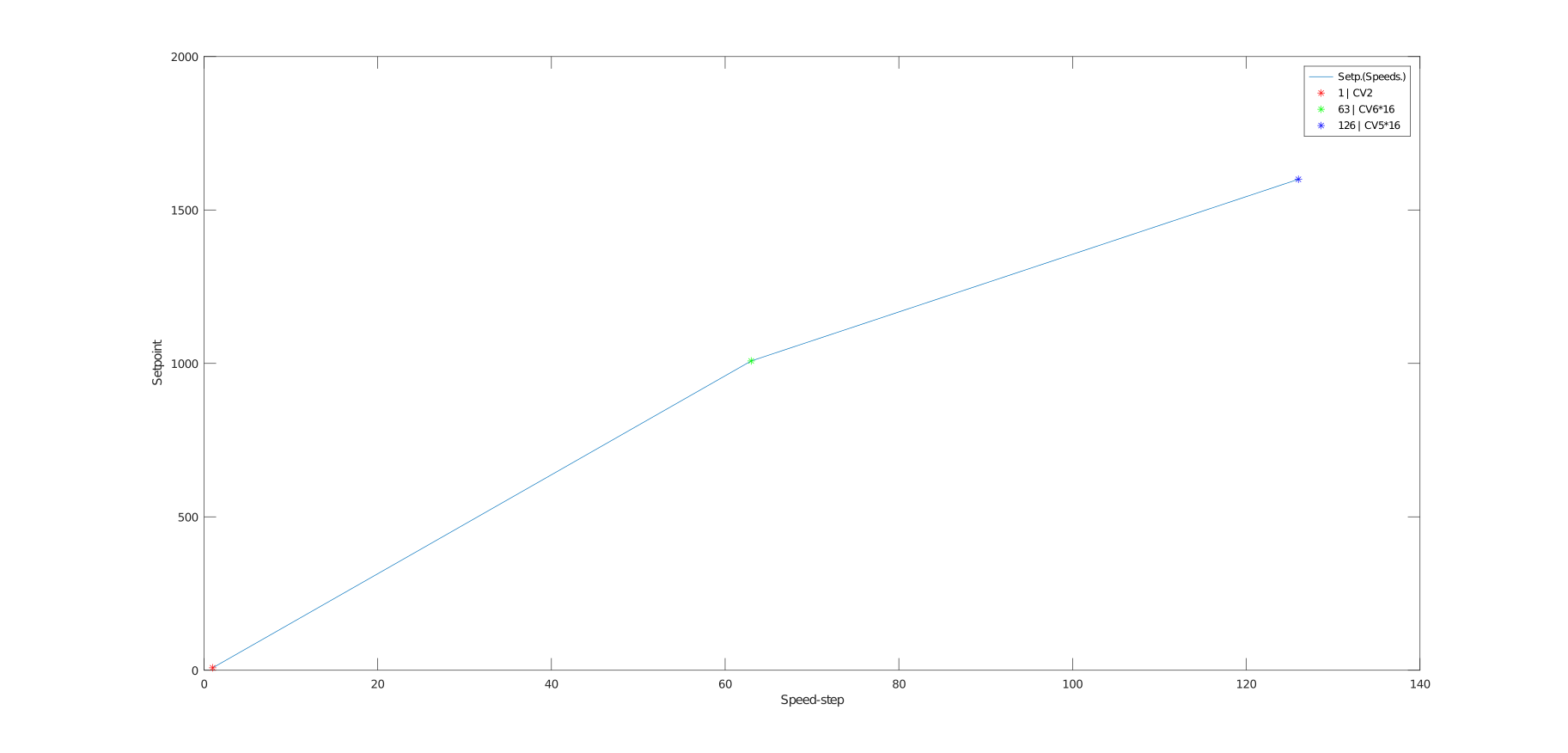
Speed Table
\(v_{min} = CV_{2}\)
\(v_{mid} = 16 \cdot CV_{6}\)
\(v_{max} = 16 \cdot CV_{5}\)
The figure above shows how the speed steps can be configured using the corresponding CVs. The red * represents \(v_{min}\) which is always at speed step 1, the green * shows \(v_{mid}\) at speed step 63, and the blue * shows \(v_{max}\) at speed step 126.
CV List
\(CV_{1}\) - Basic address
Short DCC address
\(CV_{2}\) - \(v_{min}\)
Min motor voltage/speed is: \(v_{min} = CV_{2}\)
\(CV_{3}\) - Acceleration rate
The time for one discrete acceleration time step can be calculated as \(CV_{3} \cdot CV_{175}\).
Note
Base speed steps are always 128/126 steps.
\(CV_{4}\) - Deceleration rate
The time for one discrete deceleration time step can be calculated as \(CV_{4} \cdot CV_{175}\).
Note
Base speed steps are always 128/126 steps.
\(CV_{5}\) - \(v_{max}\)
Max motor voltage/speed is calculated as: \(v_{max} = 16 \cdot CV_{5}\)
\(CV_{6}\) - \(v_{mid}\)
Mid motor voltage/speed is calculated as: \(v_{mid} = 16 \cdot CV_{6}\)
\(CV_{7}\) - Version No. (Read-Only)
Writing a value of 7 triggers an ADC offset adjustment.
\(CV_{8}\) - Manufacturer (Read-Only)
Default = 13 = Public Domain & Do-It-Yourself Decoders
Even though \(CV_{8}\) is defined as a Read-only CV, writing a value of 8 resets all CV values to the default values in CV.h.
\(CV_{9}\) - Motor PWM Frequency
\(f_{PWM_{MOTOR}} = (CV_9 \cdot 100 + 10000) \, Hz\)
\(CV_{11}\) - Packet timeout
If no package is received for \(x = CV_{11}\) seconds the decoder will automatically stop the motor (Emergency Stop).
\(CV_{12}\) - Permitted operating modes
Currently, DCC Digital mode is the only supported mode.
\(CV_{17}\) & \(CV_{18}\) - 14-Bit extended/long address
Address is only used if bit5 of \(CV_{29}\) has a value of 1.

Bit15 and bit14 which correspond to bit7 and bit6 of \(CV_{17}\) are always 1. \(CV_{17} = 192\) & \(CV_{18} = 0\) is also not a valid address.
Otherwise, the valid value range of \(CV_{17}\) ranges from 192 to 231 and 0 to 255 for \(CV_{18}\) respectively.
\(CV_{29}\) - Decoder Configuration
Bit0 is can be used to reverse motor direction, i.e., 0 = normal, 1 = reverse.
Bit5 switches between basic and extended addressing modes, i.e., 0 = basic address, 1 = extended address.
The other 6 bits are currently not in use and therefore irrelevant.
\(CV_{31}\) & \(CV_{32}\) - Extended CV pointer (Read-Only)
Not in use.
\(CV_{116}\) to \(CV_{171}\) - PWM Slice configuration

Every slice controls two independent output channels, duty cycle from 0% to 100% inclusive, and can be configured with several parameters:
Wrap (16Bit): Sets the slice time period of x cycles - effectively determining the frequency
Clock Divider: Additional clock divider
Level Channel A / Level Channel B (16Bit each): Determining how many of the x cycles the signal is at a high level - effectively determining the duty cycle
To see which CVs correspond to which slice and channel, it is advisable to use CV.h as a reference.
The PWM frequency is calculated as follows: \(f_{PWM} = \frac{125 \, \text{MHz}}{(CV_{\text{clk_div}} + 1) \cdot (CV_{\text{wrap}} + 1)}\)
The duty-cycle can be calculated as follows: \(D = \frac{CV_{\text{Level}}}{CV_{\text{wrap}} + 1}\)
A more detailed explanation regarding PWM can be found in the RP2040-Datasheet - Chapter 4.5.